For earaches, swimmer’s ear, blocked ears or feeling like you’re on the cusp of an ear infection, learn how to massage pressure points on your feet to get better faster. Discover two Chinese Reflexology points that are great for your ears.

How Chinese Reflexology Works
Chinese Reflexology is based on Traditional Chinese Medicine, an ancient healing art over 2,000 years old. The ancient Chinese identified and mapped energy meridians (pathways) in the body where qi flows. Qi is your body’s life force. When qi is abundant and flowing smoothly, your body is stronger, healthier, more resilient and heals faster.

This network of meridians is like built-in circuitry that enables you to strengthen and balance your body’s qi. Because the meridians flow throughout your body and your feet, you can press reflexology points on your feet to direct healing energy to different areas of your body. Different reflexology points on your feet connect to different parts of your body.
When you massage a reflexology point, it increases the flow of qi to the corresponding area of your body. An increase in the flow of qi helps improve blood circulation to the area. This results in more oxygen to help with healing, and it also supports the body in flushing and clearing away toxins.
And that’s how you support your body’s natural healing process with Chinese Reflexology. When you massage the reflexology points for the ears, it’s extremely beneficial for swimmer’s ear, plugged ears, earache, and an ear infection. You’re helping your body heal.
Chinese Reflexology Ear Points
Some Chinese Reflexology points are difficult to locate, but the ear reflexology points are some of the easiest pressure points to locate and massage.
I use these points quite regularly during the summer months. That’s because I love to swim!
However, if I swim more than twice a week, the regular exposure to pool water can sometimes irritate my ears. While I do wear swimming earplugs, I find that the water still trickles into my ears. As a result, if I’m swimming a lot, I will massage the Chinese Reflexology points for my ears right after I swim and for a day or two afterwards.
When I do this, it improves the flow of qi, oxygen and blood to my ears, and this helps my body do what it needs to do to in order to restore balance. In the rare instances where I start to feel a bit of pressure in my ears or notice a touch of swelling in the lymph nodes near the side of my neck (indicating my body is trying to fight something off near there), I’ll massage the ear points more frequently, and will avoid getting an ear infection. Yay!
Read more details about the ear reflexology massage routine below.
Pressure Points to Massage for Ears
Please note that the information in this article is for educational purposes and does not replace seeing a medical practitioner. However, you can learn how to massage these reflexology points to support your body’s natural healing process, which helps you heal faster.
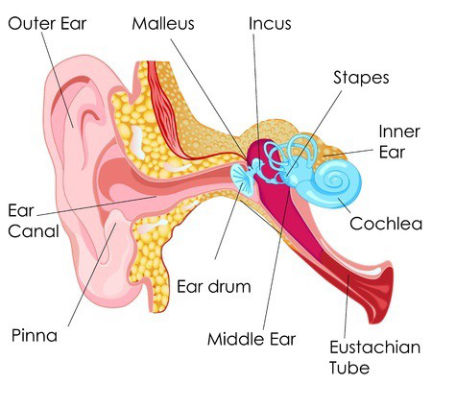
Before we begin, let’s quickly look at ear anatomy. As you can see in the diagram, there’s an outer ear, which includes the visible part of your ear, or what we commonly refer to as ears.
Deeper inside your head are nerves and receptors related to balance and hearing. These are considered to be part of the inner ear.
Similar to the structure of the ears, there are two Chinese Reflexology points for the ears—one for the outer ear and one for the inner ear.
But since everything in your body is interconnected, you can’t say the outer ear point is 100% for just the outer portion of the ear, or that the inner ear reflexology point is 100% for the inner ear. There’s going to be some overlap, and often, if one area of the body is out of balance, there may be an impact on the surrounding areas, too.
Thus, it’s a good idea to massage both of the Chinese Reflexology pressure points for the ears. Let’s get started with the outer ear reflexology point.
Chinese Reflexology Outer Ear Point

The outer ear reflexology point is located on the underside of both your pinky toe and fourth toe. It’s the part of the toes underneath the toe pads, and also includes a section along the top of the ball of the foot directly beneath the toes. It’s a U-shaped reflexology area.
The reflexology point on the left foot corresponds to the right ear, and the point on the right foot corresponds to the left ear.
To massage the outer ear pressure point, use your thumb tip to press and massage the area in an up and down motion, moving towards the toe tips and then back down to the bottom of the U-shape. Make your way across the fourth toe, along the bottom of the U, and then finish by massaging the pinky toe.
Generally speaking, you want to feel like you’re pressing on your toes, but not too hard. The toe bones are small and delicate, so you don’t want to irritate them. I would recommend using the amount of pressure that you would use to wash a pen mark off the back of your toe.
You want to err on the gentle side because it’s possible to irritate a reflexology area by using too much pressure, or massaging too frequently or for too long. This is counterproductive for healing because irritating a reflexology point on the foot can actually cause issues in the corresponding area of the body. So be kind and gentle to your toes.
Inner Ear Chinese Reflexology Point

The inner ear reflexology point is located on the top of your foot. It’s a small oval at the base of the toes where the fourth and fifth toes meet.
Similar to the reflexology point for the outer ear, it’s opposite foot for opposite ear. E.g. Left foot for right ear, and vice versa.
To massage this point, use the knuckle of your index finger to press onto the point. Then twist your knuckle back and forth like you’re wiggling a doorknob back and forth. Press hard enough to feel it, but not too hard.
You want to be careful because the tops of your feet have less padding than the soles. Since the bones are delicate and the skin is much more sensitive here than the bottom of the feet, do not over-massage this point.
Use enough pressure that you can feel it, but be mindful not to cause any irritation to the skin or bruising to the area. Because the skin is delicate, use massage oil to reduce friction as this will help to minimize skin irritation.
Recommended Reflexology Routine for Earache, Ear Infection, Swimmer’s Ear and Blocked Ears
After you’ve seen your health care practitioner, here’s a reflexology routine to help support your body in recovering faster:
- Massage both the inner and outer ear reflexology points on each foot for 30 seconds each, twice a day for 2 to 3 days.
- Do not massage this point more than three days in a row because you should be seeing improvement at this point. If not, go see your health practitioner.
Over-massaging your reflexology points can irritate the skin of the feet or the toe bones, and even cause bruising. Irritation to the feet can disrupt the flow of qi through the corresponding area of the body. As a result, you do not want to over massage this point by massaging too vigorously, too long, or too often.
Chronic Ear Issues Like Hearing Loss, Tinnitus or Vertigo
If you get chronic ear infections, or have hearing loss, tinnitus, dizziness, or vertigo, then the problem isn’t your ears. This is a counterintuitive concept, and very different from how we look at things from a western perspective.
In Traditional Chinese Medicine, if you have chronic ear issues, it’s not an ear problem.
Instead, there’s an underlying imbalance in your body that needs to be addressed. The ear issue is a symptom of the imbalance. Thus, massaging your ear reflexology points will not address the root problem, so the condition will persist.
When there’s a chronic condition such as tinnitus or hearing loss, this is a complicated health imbalance from a Chinese Medicine perspective. Treatment will vary depending on the individual, and what’s out of balance in their body. There’s no one-size-fits-all solution when it comes to Chinese Medicine. You need a custom treatment plan for your body’s imbalances.
To learn more, I would recommend getting started by reading my book, Soul Guidance, or enrolling in one of my more in-depth reflexology courses, or joining the Sole Circle, my online resource of self-care for busy people. The root imbalance depends on your body constitution, lifestyle, and the mind/body connection. There’s also an introductory workshop recording, Energize Your Eyes and Ears, that gives you a high level understanding about the potential imbalances related to hearing and other ear issues.
A one-time ear infection or irritation from swimming would be considered relatively simple to treat from a Chinese Medicine perspective. That’s because there’s an external element (water) that has caused the imbalance in the body.
When you massage your ear reflexology points, you’re sending healing qi, blood and oxygen to the ears, which helps support your body’s natural healing process. That’s why a quick reflexology boost for the ears will help you get better, and it’s the perfect complement to the treatment protocol of your health practitioner.
Hopefully you don’t have an ear infection, blocked ears, or swimmer’s ear right now. If you do, try massaging the pressure points on your feet. The inner ear and outer ear reflexology points are great tools to add to your natural health toolkit, so you may also want to bookmark this page. Then go outside and enjoy the rest of your summer!